Article: How to Choose a Wedding Band for a Low-Profile Engagement Ring
How to Choose a Wedding Band for a Low-Profile Engagement Ring
Low-profile engagement rings have become one of the most loved styles in my studio. They sit close to the hand, they're comfortable to wear every day, and they don't catch on everything you touch. But they raise one very common question: what wedding band will sit nicely beside it?
Here's what I talk through with every couple who comes to the studio, so you can find a band that feels made for your ring, because ideally, it will be.


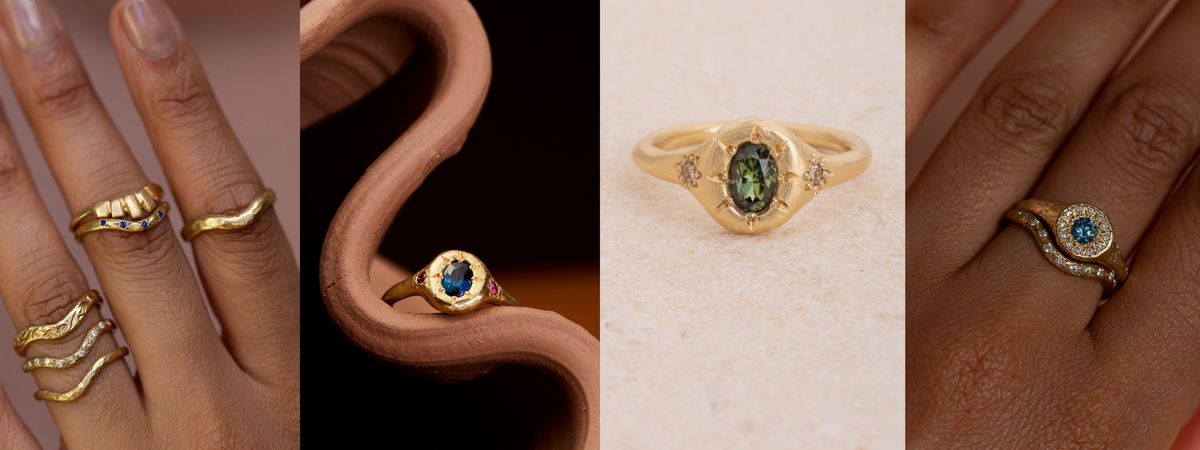
Low-profile engagement rings with curved bands sitting snugly beside them
Why low-profile rings change the question
A tall, claw-set solitaire usually leaves room underneath for a straight band to slide in. A low-profile ring is different. The stone and setting sit right down on the finger, and many low-profile designs, like signet-style faces or sculptural bezels, are wider than the band at the front. Put a straight band beside one and you'll often get a small gap, or the rings will push against each other and twist.
That's not a flaw in either ring, it just means the band needs to be chosen (or shaped) with the engagement ring in mind.
Straight, curved or fitted?
- Straight bands work well when your engagement ring's setting is narrow, or when you're happy for a little space between your rings. Some people love that gap, it lets each ring be seen on its own.
- Curved bands arc gently so they nestle around the front of your engagement ring. They're the easiest way to get a flush, seamless stack. My curved wedding bands are designed to sit beside most low-profile rings.
- Fitted bands are shaped by hand to follow the exact outline of your engagement ring. They're the most precise fit of all, and I can make one for a ring from my collections or one you already own.


The same Breeze band, straight and curved
Choosing the width
Width changes the whole feel of a stack. As a general guide:
- 2mm is fine and delicate. It lets your engagement ring take centre stage, and it's lovely if you'd like to add more bands over time. Try the Curved Breeze 2mm.
- 3mm is a balanced everyday width that holds its own beside most engagement rings, like the Curved Breeze 3mm or the engraved Whisper Ring.
- 4mm and wider makes more of a statement. Wider straight bands like the 5mm Breeze often suit a ring worn on its own, or on the other hand.
A good rule of thumb is to look at the width of your engagement ring's band and setting, then choose a band that's similar or a little finer. Also remember that wider bands feel snugger on the finger, so you may need a half size up for anything 4mm or more.


A fine 2mm curved band, and a balanced 3mm
Plain, textured or set with stones?
A plain or textured band keeps the focus on your engagement ring, and it's the most hard-wearing option. My plain wedding bands carry the same hand-worked texture as my engagement rings, so they sit naturally together.
A gemstone band adds sparkle and colour. The Curved Rosette holds eleven white diamonds (or five blue Australian sapphires) in rosette settings that sit neatly on the band. If you choose a stone-set band, it's worth checking how the stones meet your engagement ring, so the two don't rub against each other over time. Explore all my gemstone wedding bands.


The Curved Rosette in white diamonds, and the Daisy Chain in champagne diamonds
Match your metal
For rings worn side by side every day, I usually recommend the same metal and carat as your engagement ring. Different gold alloys have slightly different hardness and colour, so matching them helps the pair wear evenly and keeps the colour consistent over the years. All my bands are made in recycled gold, in 9ct, 14ct or 18ct yellow gold, or 9ct or 18ct white gold.
One band, or a stack?
There's no rule that says you can only wear one. Many people wear a band on either side of their engagement ring, or add a new one for an anniversary or a new baby. Curved bands work beautifully here, because they frame the engagement ring from both sides.


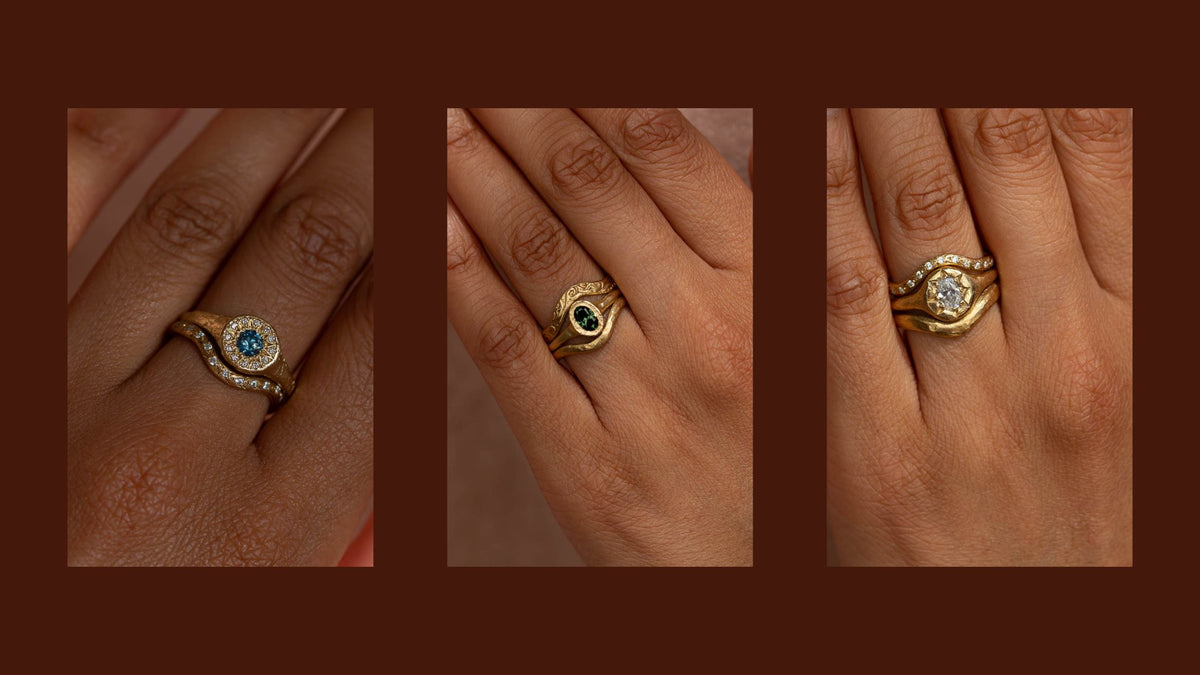
A band on either side, and a single curved band with a halo signet
Try them together
The best way to choose a wedding band is to see it beside your engagement ring. You're very welcome to book an appointment in my studio in the Nicholas Building in Melbourne and bring your ring along. If it isn't one of mine, that's fine too, I can shape a band to fit almost any ring. If you're further away, I'm happy to meet virtually, or you can start a bespoke enquiry with photos of your ring.
Or start exploring: curved wedding bands, all wedding bands, and bands ready to ship.
x Ada